
The Law Soda Crowd Startup Initiative ("The Crowd Startup") is a program offered by Law Soda designed to bring talent together and accelerate startup formation through shared ownership. Rather than waiting on traditional hiring or funding routes, a defined group of founders collectively form, own, and govern a company from inception. The structure emphasizes shared risk, aligned incentives, and long-term value creation.
The Crowd Startup Founder Overview
A Letter to Prospective Founders
If you are reading this, you are likely here for one of a few reasons.
You may be unemployed or underemployed. You may have skills, experience, or talent that has been repeatedly overlooked. You may be applying for roles and hearing nothing back — or being passed over without explanation. You may feel that the economy is shrinking opportunities rather than creating them, and that technology, automation, and artificial intelligence are accelerating that reality rather than easing it.
You are not alone.
Many capable people are finding themselves locked out of traditional pathways — not because they lack ability, but because the structure itself has become narrow, over-saturated, and unforgiving. This document exists because waiting for permission no longer works for most people.
The Crowd Startup is an alternative model offered by Law Soda, designed to bring skilled founders together and accelerate early-stage company formation.
It is not a shortcut.
It is not a guarantee.
It is not a scheme, a pyramid, or a promise of fast money.
It is a lawful, transparent, founder-led corporate structure designed to allow a large group of individuals to build ownership together, share risk fairly, and create long-term value without requiring wealth, insider access, or full-time availability.
How Does It Work?
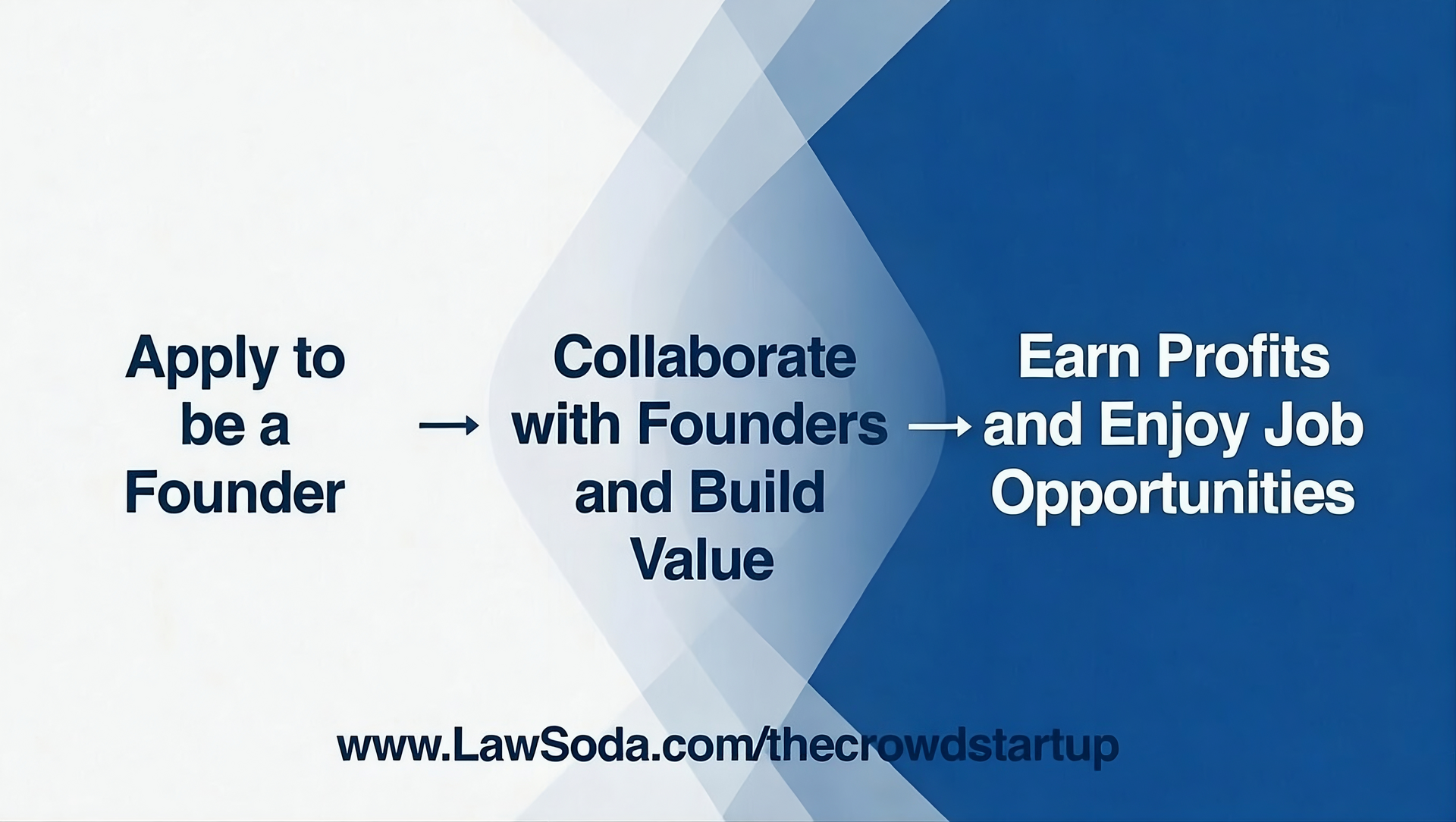
The Crowd Startup is a structured company-formation program offered by Law Soda. Through this program, a corporation is formed by 100 Founders who begin as equal initial shareholders.
Rather than relying on one or two founders with significant capital, The Crowd Startup relies on collective participation, shared governance, and structured simplicity. Each Founder contributes a modest amount to cover essential startup costs and receives ownership from the outset.
The goal is not immediate income. The goal is ownership first—followed by growth, investment, and long-term value creation.
This structure allows people who may lack capital but possess insight, discipline, or patience to participate meaningfully in building a company—without being asked to gamble their livelihood or surrender control to outsiders.
All companies formed through this program are incorporated in the District of Columbia, a strategically advantageous jurisdiction offering strong governance frameworks and proximity to national policy, regulatory, and investment ecosystems.
Incorporation in DC does not require a company to operate there or maintain offices in the District. Each company’s principal place of business—where executive decisions are made—may be located in any state and is determined through the company’s governance process. The program is fully remote-friendly, allowing founders, officers, and directors to work from wherever they are most effective while maintaining clear, stable legal and governance foundations.
The Crowd Startup is open to both U.S.-based and international founders. This program is designed for skilled individuals and teams—whether based in the United States or abroad—who want to form a U.S.-based startup as a new venture or as an independent U.S. entity connected to an existing business overseas. All companies formed through the program are incorporated in the United States as standalone entities, with full access to U.S. infrastructure, banking, and governance, regardless of where the founders are initially located. Founders may participate fully from abroad through a remote-first structure, with guidance on staffing, operations, and future relocation pathways addressed as the company grows and leadership needs evolve.
Who The Crowd Startup Is Especially Well Suited For
The Crowd Startup is designed to meet people where they already are — socially, professionally, and economically — and help formalize collaboration that is often already happening informally.
Below are examples of situations where participation in the program can be particularly well-timed and practical.
College Students and University Communities
College environments are uniquely well-positioned for collaborative venture building.
Students already:
In many cases, founders may come from the same school, same program, or even the same classes, making collaboration natural rather than forced.
Given current economic conditions, many graduates — in the U.S. and abroad — are completing degrees only to find that:
Participating in a startup before graduation can allow students to:
While outcomes are never guaranteed, it is reasonable that by graduation:
Founders are not limited to C-suite roles. As companies scale, operational positions — project management, operations, HR, regional management — often emerge, and early founders are frequently the most qualified to fill them.
Working Professionals Living Paycheck-to-Paycheck
Many participants already have stable employment, yet still find themselves:
Even good jobs can become unstable quickly due to:
The Crowd Startup may be suitable for individuals who want to:
This is not about abandoning work — it is about adding resilience.
Social, Professional, and Community Groups
Many startups begin where people already gather:
These groups already have:
The Crowd Startup provides a framework to:
The program is not tied to any religious, political, or ideological organization, but it is well-suited to groups that already function as communities.
Why Timing Matters
The program is not designed for “someday.” It is designed for people who recognize that:
Participation does not guarantee outcomes. What it provides is structure, alignment, and a legitimate starting point.
How a Startup Creates Value — and How Founders Benefit
Many people instinctively think a company only has value once it has money in the bank. In reality, startups work differently. In their early stages, companies focus first on creating value, not extracting profit—and that value is what ultimately turns into real financial opportunity for founders.
Value can exist even when a company’s bank account is close to zero. A startup may be valuable because it has:
Independent professionals—called business valuation experts—specialize in assessing these factors. Much like a real estate appraiser evaluates a house, a valuation expert evaluates what a company is reasonably worth based on its traction, potential, and structure—not just its cash balance.
A Simple Example
Each Founder in The Crowd Startup begins with 5,000 shares, representing 0.5% ownership of the company.
Imagine a Founder joins with:
That initial capital, multiplied across 100 Founders, helps cover early legal formation, structure, and foundational costs. But the real work happens next: building value together.
Suppose that after a period of growth—through users, visibility, or product progress—a valuation expert determines the company is worth $2.5 million, even if profits are still minimal.
Because each Founder owns 0.5%, their shares now represent approximately $12,500 in value.
That value exists whether or not anyone has taken a salary.
What Can a Founder Do at That Point?
Founders typically have several paths available:
As the company continues to develop, that valuation may increase. If the company later reaches a $5 million valuation, that same ownership stake would reflect even greater value.
Dividends: Another Way Founders Can Earn
Selling shares is not the only way founders can benefit.
Once a company becomes profitable, the Board may approve dividends—cash distributions paid to shareholders based on ownership. This allows Founders to receive income while still keeping their shares and remaining part of the company’s future.
Dividends are not guaranteed and are only issued when financially appropriate, but they are a common mechanism in successful, well-run companies.
Beyond Ownership: Roles Inside the Company
Founders are not limited to being passive shareholders.
As companies grow, they often create roles such as:
C-level executive and Director roles are reserved exclusively for Founders, as set forth in the company’s bylaws and not subject to change. For other leadership roles—such as project management, operations, strategy, or senior management—Founders are given strong preference whenever possible, given their early involvement and deep understanding of the company from inception. A Founder may ultimately earn income through employment, dividends, appreciation in ownership value, or a combination of all three.
Why 100 Founders?
The number is intentional.
One hundred Founders creates:
At this scale, no single Founder controls the company, and no small group can quietly reshape it for personal gain. Decisions require structure, transparency, and collective accountability.
This is not about dilution of importance — it is about shared legitimacy.
Founder Status and Identity
All initial 100 participants are Founders.
This is not symbolic language. It is factual and permanent.
Each Founder:
Future investors or shareholders are not Founders.
The distinction matters. This company begins with people, not capital.
Ownership Structure
At formation, the corporation authorizes 1,000,000 shares.
These are allocated as follows:
No shares are issued casually.
No shares are created silently.
No dilution occurs without formal approval under the bylaws.
What Founders Are — and Are Not — Required to Do
Founders are not required to:
Ownership is not contingent on labor.
This is intentional. Many Founders will be working jobs, searching for work, caring for families, or navigating uncertainty. The structure respects that reality.
However, participation is welcomed.
Founders who wish to contribute may do so by:
Some weeks may require no action at all.
Other times may involve brief reviews or votes.
Participation occurs when needed, not on a fixed weekly schedule.
Governance: How Decisions Are Made
Shareholders (Founders)
The 100 Founders collectively serve as the shareholder body.
Only original Founders may:
This preserves the integrity of the founding group permanently.
Shares may be inherited or transferred, but governance rights remain tied to Founder lineage, as defined in the bylaws.
Board of Directors (9 Seats)
The Founders elect 9 Directors.
Why nine?
Directors:
This separation prevents self-dealing and protects fairness.
Officers (5–7 Roles)
Officers are appointed by the Board from among the Founders who are not Directors.
Standard roles include:
Officers:
Failure to perform duties, abandonment of role, or removal for cause results in forfeiture of unvested shares.
Chief Legal Officer
The role of Chief Legal Officer is held by Law Soda, as a contractual governance position embedded in the company’s bylaws to ensure continuity, compliance, and protection from formation through growth. While Law Soda serves as the designated CLO entity, Attorney Kevin F. McDaniel, founder and CEO of Law Soda, personally provides hands-on in-house counsel during the formation stage, including founder organization, governance structuring, equity setup, and initial compliance. As companies mature, legal support may transition to other qualified attorneys within the Law Soda network based on evolving needs, while the CLO role itself remains continuously fulfilled through Law Soda to preserve stability and institutional continuity.
This position:
This ensures that governance integrity is maintained from formation through growth.
Time Expectations
Founders
Directors
Officers
Time increases only with responsibility and opportunity — never by surprise.
Capital Contributions
Some capital is necessary to form and operate a corporation.
These costs include:
Because this is a crowd, the burden is shared.
For example:
This is not capital-intensive by design.
Risk, Reality, and Trade-Offs
This is not guaranteed income.
Shares may never become liquid.
The company may fail.
Time invested may not pay off.
However:
This structure favors patience over speculation.
Continuity and Inheritance
Founders are human. Time passes.
Each Founder may designate a beneficiary for their shares.
Beneficiaries inherit ownership under defined rules.
Successor beneficiaries may also be designated.
This ensures:
The company outlives individuals — by design.
Why This Exists
This model exists because talent is being wasted.
Because opportunity is unevenly distributed.
Because ownership has been restricted to those with access.
Because waiting to be chosen no longer works.
This is a structure for people who are done waiting.
The Next Step
If this resonates with you, the next step is simple.
Complete the Founder Interest Form below.
This step:
Once the Founder group reaches 100 participants, formal formation begins.
Until then, nothing is owed.
If you’ve been overlooked, this is a way to build something that cannot overlook you.
Founder Intake & Expression of Interest
Purpose of This Form
This form is the next step for individuals who have reviewed The Crowd Startup Founder Overview and wish to:
Submitting this form does not obligate you financially, does not guarantee acceptance, and does not create any legal partnership.
It allows us to understand who you are, what you bring, and where you may fit.